News
📢 Call for Papers: “Menstrual Practices, Beliefs, Taboos, Health and Management : An Interdisciplinary Dialogue on Menstrual Dignity”
Call for papers
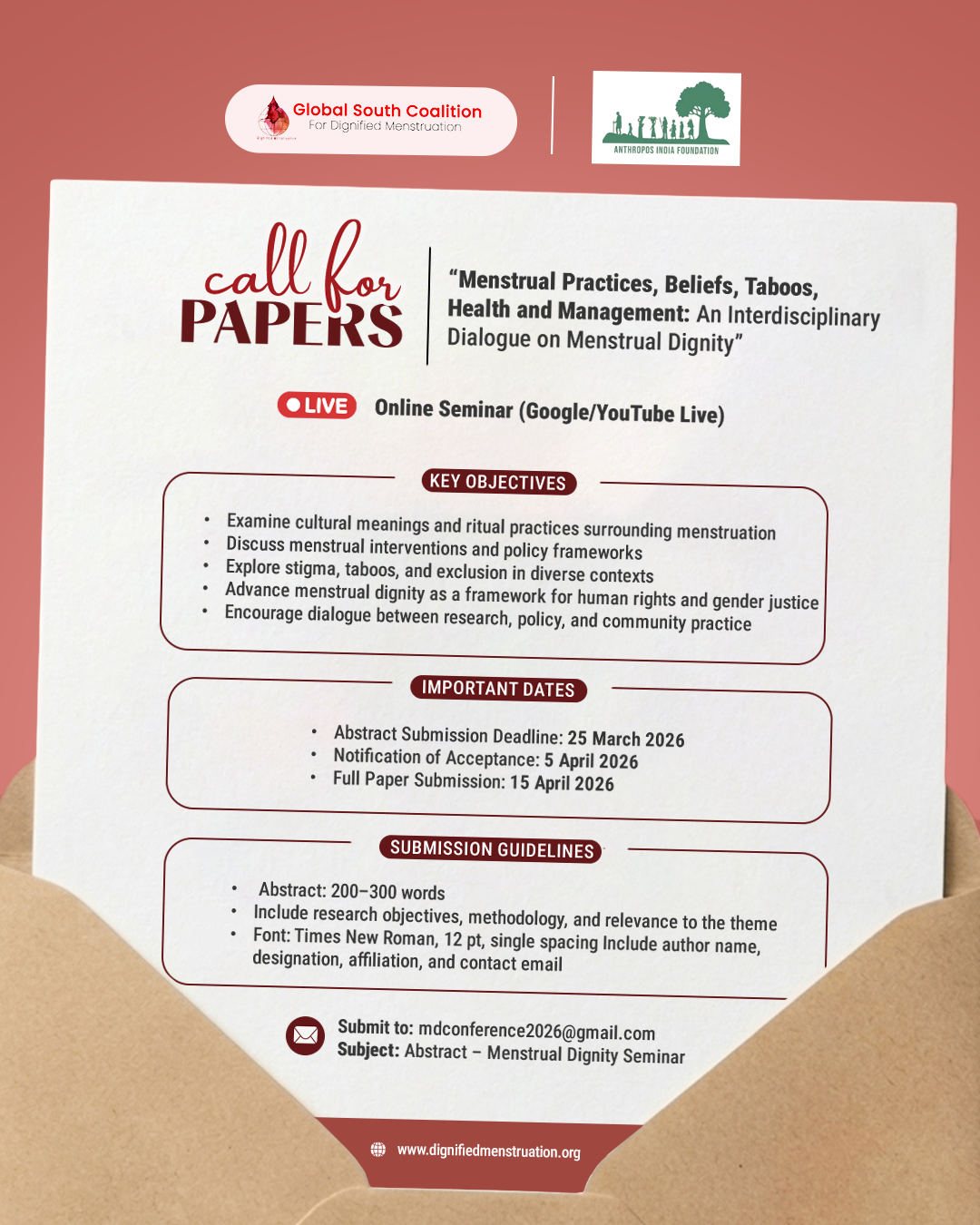
“Menstrual Practices, Beliefs, Taboos, Health and Management : An Interdisciplinary Dialogue on Menstrual Dignity”
Date: [To be announced]
Online Seminar (Google/YouTube Live) Jointly organized by:
ANTHROPOS India Foundation, New Delhi &
Global South Coalition for Dignified Menstruation
Menstruation, though a natural and universal biological process, remains deeply entangled with cultural beliefs, social taboos, and gendered inequalities. Across societies, menstrual practices are shaped by local cosmologies, moral codes, and ritual purity systems that continue to influence women’s everyday lives. Despite policy attention and awareness campaigns, menstruation often remains a domain of silence, shame, and exclusion.
From a public health viewpoint, menstrual health and management (MHM) remains critical to achieving reproductive health, education, and gender equality. However, access to menstrual products, WASH facilities, and accurate information continues to be unequal. Government programs such as the Menstrual Hygiene Scheme (MHS) and global initiatives by WHO and UNICEF have reframed menstruation as a developmental and rights issue. Yet, policy interventions often fail when they ignore the socio-cultural realities in which menstruation is embedded.
The idea of menstrual dignity bridges these domains—linking the material and the moral, the biological and the social. It calls for a life cycle and holistic approach that ensures not only access to menstrual products and WASH facilities but also freedom from shame, discrimination, and exclusion. Menstrual dignity emphasizes agency, respect, and bodily autonomy, affirming menstruation as a natural and dignified part of life.
This online seminar, jointly organized by Anthropos India Foundation & Global South Coalition for Dignified Menstruation, seeks to foster an interdisciplinary dialogue between anthropology, public health, and gender studies to explore menstrual practices, beliefs, and taboos within the broader framework of menstrual dignity.
From an anthropological perspective, menstruation has been understood as more than a biological process—it is a social and cultural event that embodies systems of purity, pollution, and power. The persistence of seclusion practices, ritual prohibitions, and stigmatizing discourses highlights how menstrual norms both reflect and reinforce gender hierarchies.
This seminar aims to provide a platform to collaborate with academics, researchers, practitioners, and activists to exchange perspectives and experiences on menstruation as a site of culture, health, and human rights.
Objectives
- To examine the cultural meanings and ritual practices surrounding menstruation.
- To discuss menstrual interventions and policy frameworks related to menstrual discrimination.
- To explore various forms of menstrual discrimination such as stigma, taboos, exclusion etc. across diverse contexts.
- To advance the framework of menstrual dignity as central to human rights and gender justice.
- To encourage dialogue between research, policy, and community-based practice.
Submission Guidelines
- Abstract length: Submit an abstract of 200-300word outlining your proposed paper, including- research objectives, methodology, key findings (if applicable) and relevance to the theme.
- Formatting: Times New Roman, 12-point, single spacing.
- Author details: Name, designation, institutional affiliation, and contact email.
- Submit abstracts to [email protected] with the subject line “Abstract – Menstrual Dignity Seminar.”
Important Dates
- Deadline for abstract submission: 25th March 2026
- Notification of acceptance: 5th April 2026
- Last date to Submit of full paper: 15th April 2026
- Seminar date and schedule will be shortly informed
Participation and Publication
Selected abstracts will be invited for online presentation during the seminar. Certificates will be provided to all participants. Selected papers may be considered for inclusion in an edited volume or special issue published by Anthropos India Foundation’s publishing Anthropos Books. Registration Process
Any query Contact
Convener: Anthropos India Foundation Email: [email protected]
Website: www.anthroposindiafoundation.com
Subthemes / Suggested Topics
- Cultural and religious constructions of menstruation
Menstruation's cultural and religious conceptions influence how society views gender roles, pollution, and purity. Across all traditions, they have an impact on involvement of women in religious and social life, taboos, and rituals.
- Transformations in menstruation practices across the globe Transformations in menstruation practices are taking place in organizations and countries all around the globe reflect a shift from secrecy and stigma toward awareness, health education, politics and menstrual equity. Modern discourse now emphasizes health , dignity, and the breaking of long-held taboos.
- Menstrual management and health policy
Menstrual management and health policy all around the globe aim to ensure access to menstrual products, WASH facilities, and awareness. Government and NGO initiatives focus on reducing stigma and promoting menstrual health as a public health priority.
- Inter-sectionality of caste, class, region, LGBTQUIA+, Pandemic, disasters and disability in menstrual experiences
Disparities in access to dignity are caused by the intersections of caste, class, region, LGBTQUIA+, pandemic, humanitarian settings and disability, which profoundly influence menstrual experiences all around the globe . Groups who are marginalized are more likely to experience increased stigma, marginalization, exclusion, subject to various forms of sexual and gender based violence and a lack of healthcare support.
- Menstrual stigma and exclusion in education, work, and public life.
Full involvement of women in public spaces, businesses, and educational institutions is impeded by social taboos and misconceptions around menstruation. Silence and gendered prejudice are sustained by a lack of knowledge, resources, and candid communication.
- Menstrual dignity as a framework for rights and social justice.
Menstrual dignity presents menstruation as a social justice, equality, life cycle based and human rights issue. It combats stigma and systemic prejudice by promoting respect, freedom, equality and right to non-discrimination in every aspect of menstruation from private to public sphere.
- Representations of menstruation in media, art, and literature.
Media, visual, and literary portrayals of menstruation are changing from ones of shame and quiet to empowerment and visibility. By breaking taboos, contemporary stories promote discussion on gender equality and body positivity.
- School-based education, awareness, and menstrual empowerment.
Knowledge, management awareness and menstrual empowerment are increased when menstrual education is incorporated into the school curriculum. It enables youth to confront stigma and make proactive decisions regarding their menstrual dignity.